Coal-site repurposing and infrastructure reuse
How existing site characteristics could shape a conceptual nuclear repowering pathway.
Mechanical Engineering Capstone · Nuclear Systems · 2024–2025
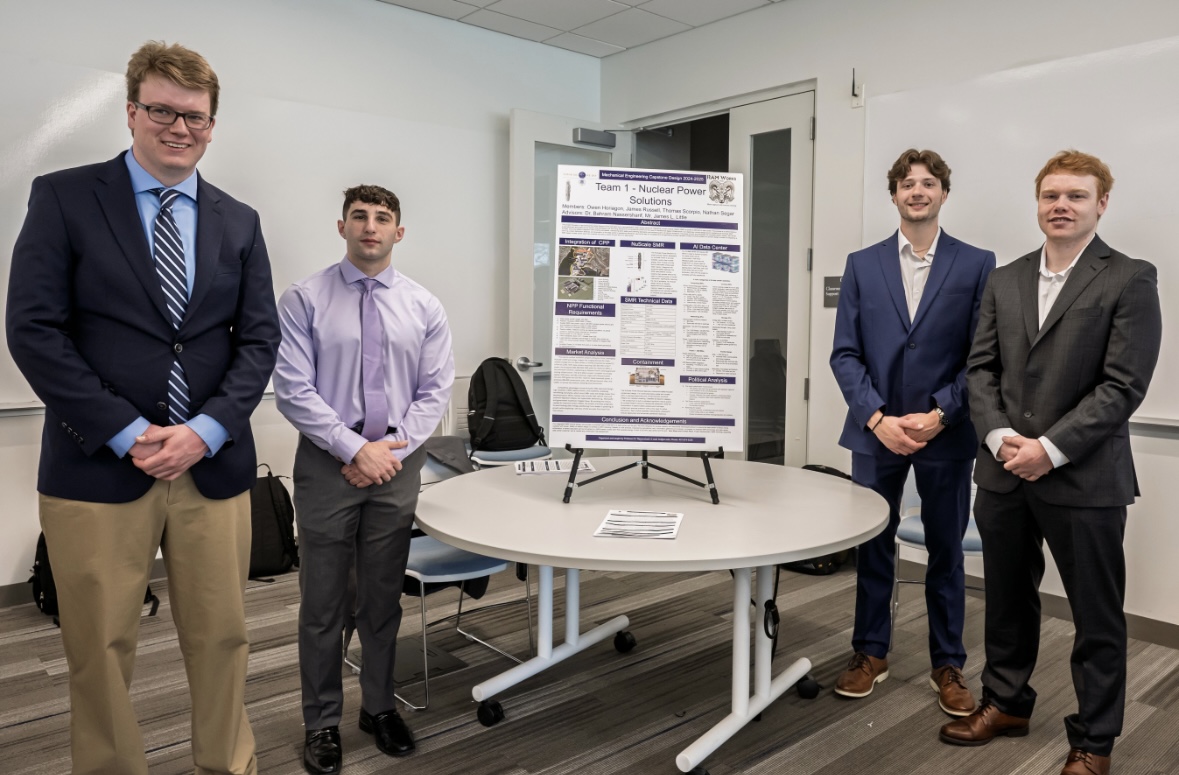
A four-person mechanical engineering capstone study exploring how retired coal-generation infrastructure could be repurposed around small modular reactor technology to support reliable, low-carbon power for a high-demand AI data center and the surrounding grid.
Systems problem
The retired Brayton Point coal facility provided the conceptual site basis for studying how coal-generation infrastructure, grid access, and industrial land-use characteristics might be repurposed. Our capstone explored how a conceptual SMR-based repowering approach could serve a high-demand, reliability-sensitive AI data center while still supporting grid-connected power delivery. The study required the team to consider site reuse, cooling, containment and passive-safety concepts, power distribution, implementation constraints, and grid connection as one integrated problem.
Team evaluation
How existing site characteristics could shape a conceptual nuclear repowering pathway.
How reactor-system assumptions influence layout, safety framing, and operations thinking.
How a 250 MW-class computing load drives electrical and thermal requirements.
How a conceptual plant could interact with external power needs and phased deployment logic.
Recruiter signal
The study connected high-level mission needs, site constraints, power demand, safety assumptions, and implementation considerations into a coherent conceptual engineering framework.
The work required power-generation reasoning, cooling awareness, grid interface thinking, and attention to how large energy systems behave beyond a single component.
Reactor safety concepts, containment, passive-safety assumptions, and operational resilience were treated as central design considerations rather than after-the-fact checks.
The capstone required clear communication across energy, computing-load, cooling, infrastructure, and implementation constraints in a four-person engineering team.
Next step
Connect with me about nuclear power systems, thermal systems, or infrastructure-scale engineering work.